PM career growth
A 90-day plan for moving into AI product management
You do not need a machine learning degree. You need working knowledge, one thing you built, and a way to talk about both.
 Akshay Sharma6 October 2026 · 3 min read
The question I hear most from the people I mentor is some version of this: "I am a product manager, or want to be one. How do I move into AI?"
Many assume they need to become engineers first. They do not. They need enough understanding to make good product decisions, and proof that they can apply it. I made a similar move myself, from cloud products at Microsoft into AI product work, and I talked through that journey on Rupinder Singh's podcast.
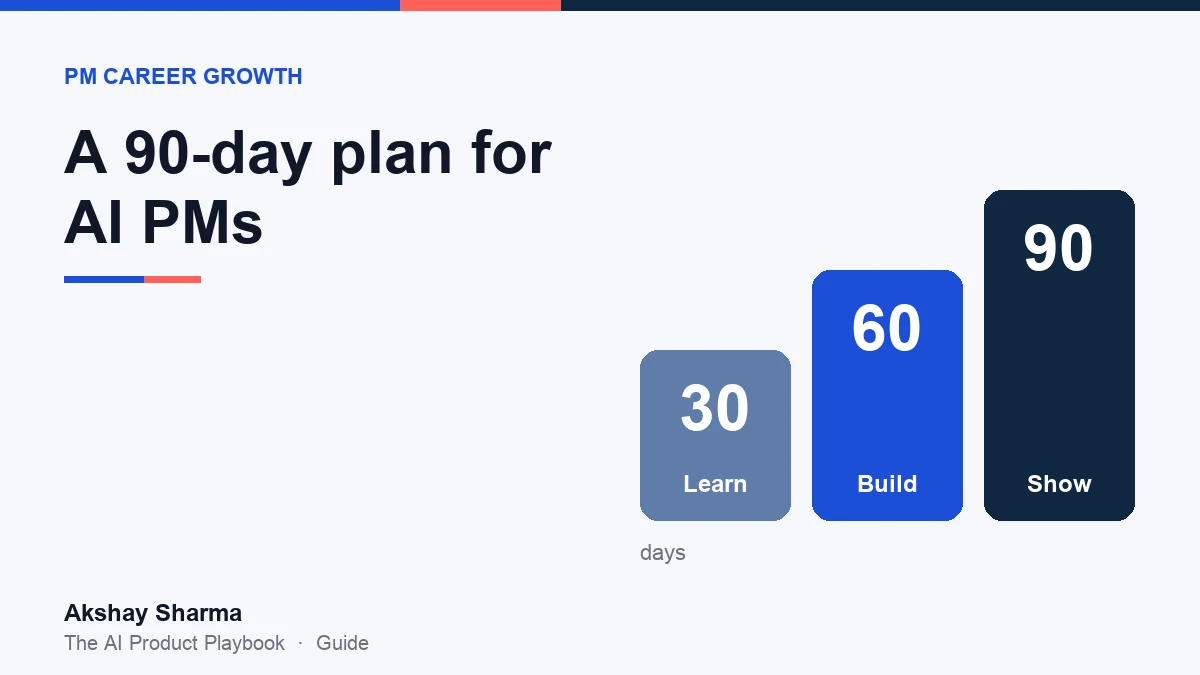
This is the plan I suggest. It takes about ninety days alongside a full-time job, at roughly five hours a week.
Days 1 to 30: learn how it behaves
Aim for working knowledge, not expertise. By the end of the month you should be able to explain each of these to a colleague in plain language.
- What a large language model does, and why it sometimes states wrong things confidently.
- What tokens, context and prompts are, and why they affect cost and speed.
- What retrieval-augmented generation (RAG) is, and when you would use it.
- What an agent is, and how it differs from a chatbot.
- What an evaluation is, and why "it looks good" is not one.
Use the tools every day while you learn. Give a model a task from your real job and watch where it fails. Reading about models is no substitute for seeing one get your own work wrong.
End-of-month check. Pick a feature in a product you use and write half a page on how you think it works and where it probably breaks.
Days 31 to 60: build one small thing
Pick a real problem, preferably from your current job, and build a working prototype. No-code and low-code tools are fine. Good first projects include:
- A retrieval assistant over your team's documents.
- A workflow agent that drafts a weekly status update from tickets.
- A classifier that sorts incoming requests into categories.
The prototype itself matters less than the decisions it forces. You will have to decide what data it needs, what "good" means, how to test it, and what it should do when it is unsure. Those decisions are the job.
My 12-week agentic AI roadmap and RAG lab handbook are free and follow this approach.
End-of-month check. Someone else can use what you built without you sitting next to them.
Days 61 to 90: turn it into evidence
Now write it up the way a product manager would.
- A one-page brief. The user, the problem and the baseline.
- A short PRD. What the AI feature does, how you evaluated it and what it does when it is wrong.
- A results note. What you measured, what failed and what you would change.
This is what you talk about in interviews. A candidate who can walk through one real build, including the parts that went wrong, stands out from one who lists courses. The AI PRD kit has templates for all three.
End-of-month check. You can explain your project in three minutes to someone outside tech.
The plan on one page
| Month | Goal | Output |
|---|---|---|
| 1 | Understand how the technology behaves | Half-page teardown of an AI feature |
| 2 | Build one small working thing | A prototype someone else can use |
| 3 | Turn it into evidence | Brief, PRD and results note |
What interviewers look for
For AI product roles, I would look for three things.
- Use case judgement. Can you tell an idea worth building from a fashionable one?
- Quality thinking. Can you define "good" for an AI feature and say how you would measure it?
- Production instinct. Do you raise risk, cost and adoption without being asked?
None of that needs a technical degree. It takes curiosity, practice and something you built yourself. The AI PM interview kit has frameworks, cases and a 14-day preparation sprint.
Mistakes I see most often
- Collecting certificates. Three courses and nothing built is weaker than one course and one prototype.
- Waiting for permission. You do not need an "AI" title to apply this to your current product.
- Hiding the failures. The part where your prototype got it wrong is the most interesting part of the story.
If you want help building your own plan, book a call.
Found this useful? Share it, or get the next one through The AI Product Playbook, my LinkedIn newsletter.