AI product management
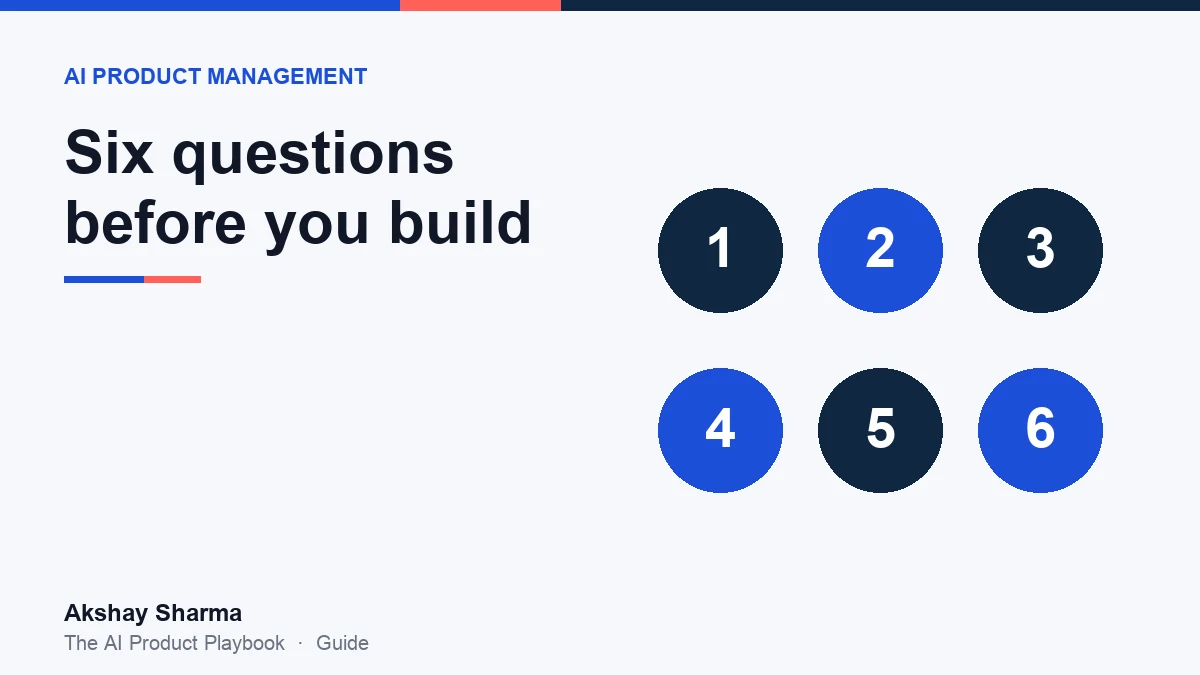
Six questions before an AI idea reaches the roadmap
Most AI ideas fail before a model is involved, because the use case was never worth solving.
 Akshay Sharma6 October 2026 · 3 min read
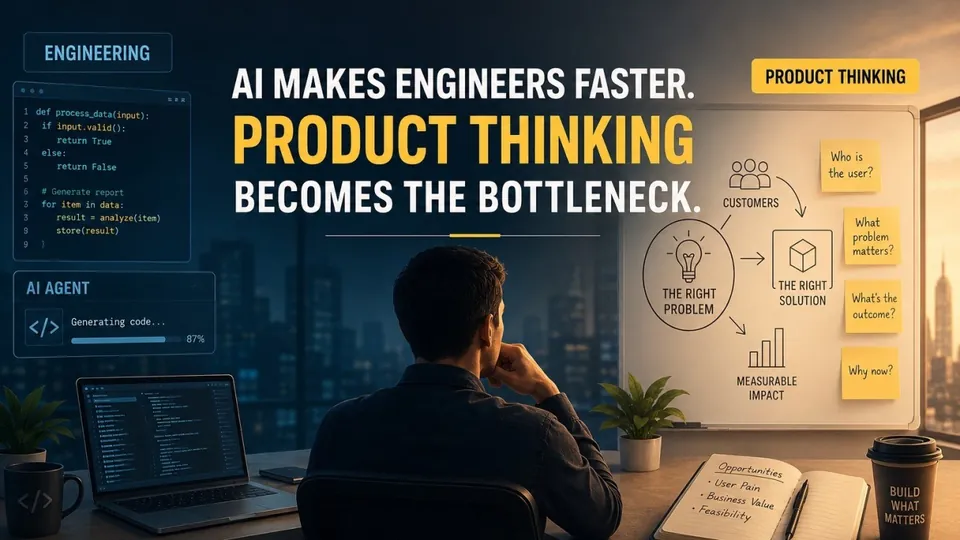
Every team now has a long list of AI ideas. The scarce skill is choosing the two that deserve a quarter of engineering time. Over the years I have helped shape 50+ AI and GenAI proposals across Azure, AWS and GCP. The ones that worked had the same shape, and the ones that stalled usually skipped the same questions.
Here are the six I ask.
1. Whose work changes, and how often do they do it?
Name the person and the task.
- Weak: "Use AI to improve insights."
- Strong: "Analysts spend two hours a day reconciling reports from three systems."
The strong version tells you who to interview, what to measure and where the feature should live. Frequency matters too. A small saving on a daily task beats a large saving on a yearly one, and gives you far more data to learn from.
2. What does it cost today?
Put a number on the baseline: hours, errors, delays or money. If you cannot measure the problem now, you will not be able to show the product helped, and the project will be judged on opinion.
This step often kills ideas, which is useful. A task that annoys everyone but takes ten minutes a week is not a product.
3. What happens when the AI is wrong?
Every model is wrong sometimes. Ask what a mistake costs and whether someone will catch it.
| If an error is… | Then… |
|---|---|
| Cheap and obvious | Good first project |
| Cheap but hard to notice | Add checks before launch |
| Expensive but reviewed by a person | Design the review step carefully |
| Expensive and unreviewed | Do not start here |
First projects should come from the top of that table. Teams that begin at the bottom spend a year on guardrails before any user sees value.
4. Is the data there?
The question is not "do we have data". It is "can the product reach the right data, at the moment it needs it, with permission to use it?" Many promising ideas stall on access, ownership or quality long before modelling becomes the issue. Find the data owner in week one, not month three.
5. Does it need AI at all?
If rules, a search box or a better form would solve it, build that. It will be cheaper, faster and more predictable. AI earns its place when inputs are messy, language-heavy or too varied for rules to cover.
I ask teams to describe the non-AI version of the solution first. Sometimes it is good enough to ship. When it is not, the gap between it and what users need is a precise description of what the model has to do.
6. How will it reach the user?
A capable model nobody uses delivers nothing. Check that the feature fits inside a workflow people already follow.
On a knowledge platform I worked on, the gains came from putting reuse inside the proposal process itself. Redundant work fell 25% and proposal preparation time fell 20%. A separate tool that people had to remember to open would not have reached that adoption, however good its search was.
Scoring the list
I score each idea from one to five on four dimensions.
| Dimension | A five looks like |
|---|---|
| Value | Large, measurable, frequent |
| Feasibility | Data is reachable and a model can plausibly do it |
| Risk | Errors are cheap or reliably reviewed |
| Adoption | Fits an existing workflow with a clear owner |
Then I look for balance. An idea scoring five on value and one on adoption loses to an idea scoring three across the board, because the second one will be in use next quarter.
Write the one-page brief
Before a PRD exists, write the answers down on one page: the user, the task, the baseline, the cost of errors, the data, and the workflow it fits into. If the page is hard to write, that tells you the idea is not ready, and you found out in an afternoon.
The AI PRD kit has the template I use, and the AI product discovery kit has an opportunity canvas for the earlier stage.
Questions to ask your team this week
- Which ideas on our list name a specific person and task?
- Which have a baseline number?
- Which would still be worth doing without AI?
- Who owns the data each one depends on?
Found this useful? Share it, or get the next one through The AI Product Playbook, my LinkedIn newsletter.